
Published 6 June 2026 · 3 min read
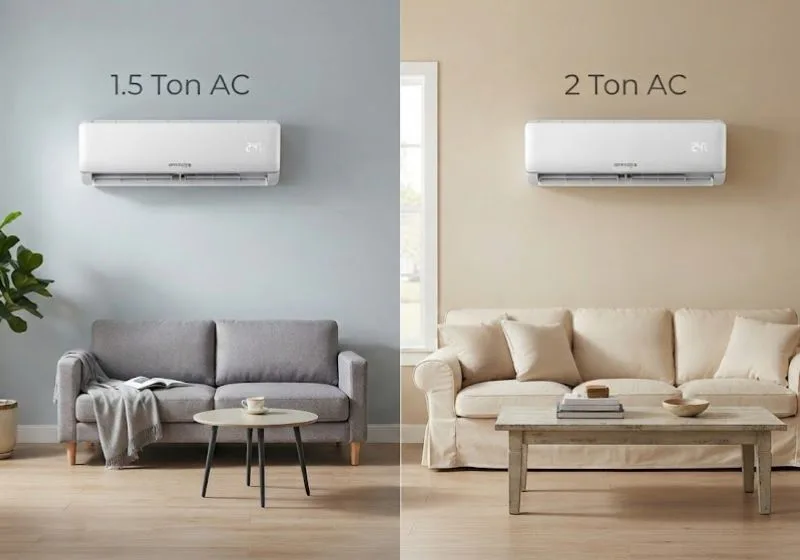
As a general guide for Hyderabad, a 1.5-ton AC suits rooms around 140–180 sq ft, while a 2-ton AC is better for 180–250 sq ft rooms or spaces with heavy sun exposure — choosing the wrong size affects not just cooling speed but long-term maintenance and running costs too.
These are general guidelines, not fixed rules — sun exposure, ceiling height, and floor level all shift the right answer in either direction. A 1-ton AC suits smaller rooms (roughly 100–140 sq ft), 1.5-ton fits the common mid-size bedroom or living room range, and 2-ton is generally for larger rooms or spaces that get significant direct sun.
An undersized unit runs almost continuously trying to reach the set temperature, which increases both electricity consumption and wear on the compressor over time. It's a common, quietly expensive mistake — the AC seems fine day-to-day, but it's working far harder than it should, which shows up later as higher bills and earlier repairs.
An oversized unit cools the room quickly but shuts off before properly dehumidifying the air, leading to a room that feels cold but slightly clammy — and frequent on/off cycling (short cycling) puts its own kind of strain on the compressor over time. Bigger isn't automatically better; matched to the room is what actually matters.
A correctly sized AC runs in a more stable, predictable pattern, which generally means more predictable maintenance needs too. An incorrectly sized unit — running constantly if undersized, or short-cycling if oversized — tends to show wear-related issues (capacitor strain, compressor stress) earlier than it should.
Not necessarily — for a standard-size bedroom without heavy sun exposure, 1.5 ton is often the better match; going bigger than needed can lead to short-cycling rather than better comfort.
It doesn't wear out faster mechanically in every case, but running near-continuously to compensate for being undersized does add more cumulative strain over time than a correctly sized unit cycling normally.
Yes — top-floor rooms typically absorb more heat through the roof, so it's reasonable to size up from what the room's square footage alone would suggest.
Buying a new AC in Hyderabad? Here's a checklist of questions to ask your installer before the job starts, to avoid common installation mistakes.
Read more →INSTALLATION & BUYINGAC-related short circuits and fire risks rise in summer. Here's how to AC-proof your home's wiring and reduce the risk before peak season.
Read more →Tell us the symptoms and your locality — we'll send a technician to diagnose it properly.